
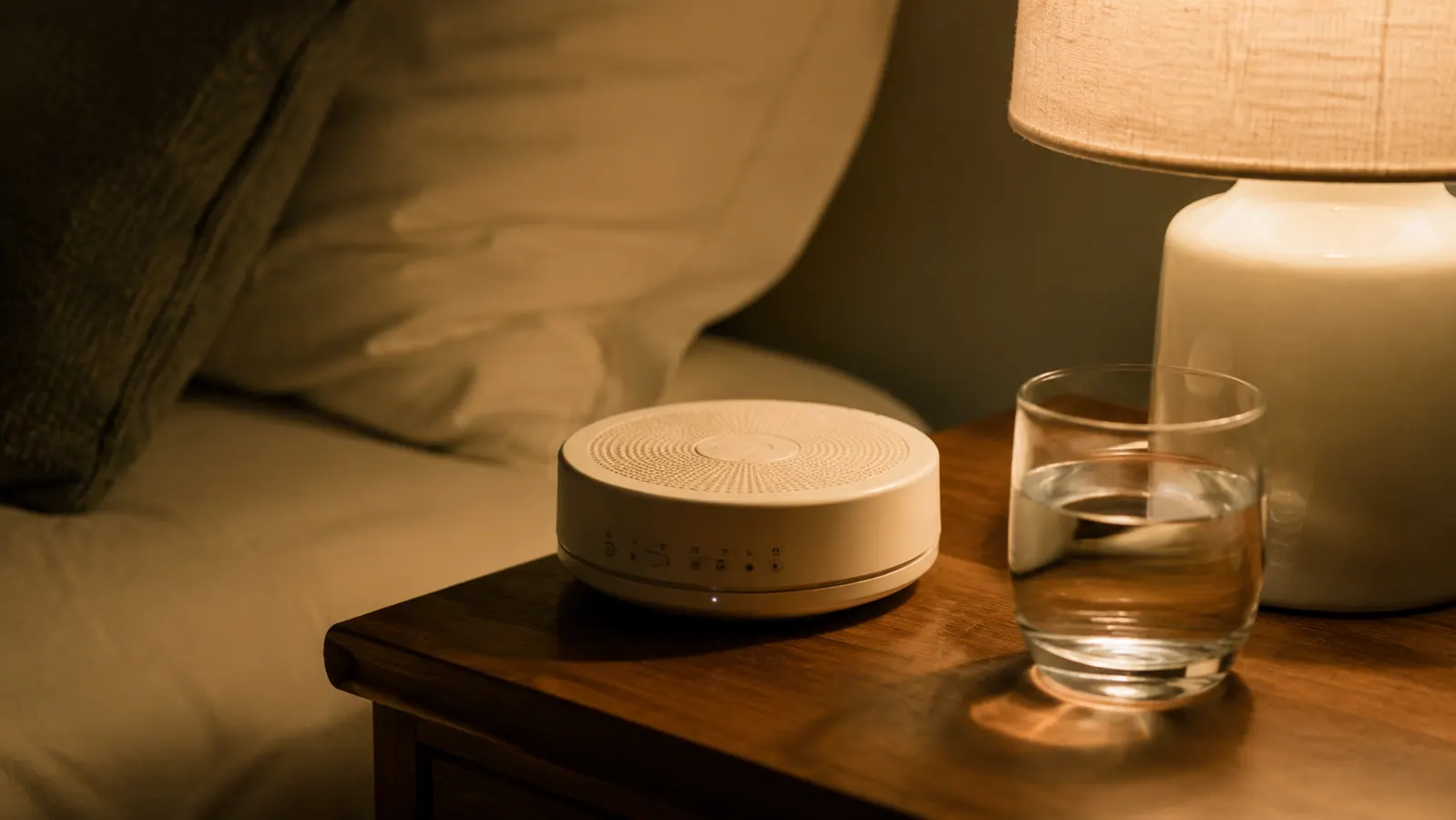
Your phone is the problem, not the solution. You already run a white noise app at night. You know you do it because the silence feels wrong, or the street outside is relentless, or your partner's breathing catches you off guard every few minutes. But here is what nobody mentions: the same screen that keeps you awake is the one you are asking to put you to sleep. A notification slips through. The battery drains and the fan sound stops at 2am. The app subscription quietly lapses. A dedicated white noise machine does not do any of that. It sits on the nightstand, it does one thing, and it does it all night.
Short answer: if you sleep with noise, a dedicated machine like the Homedics SoundSleep is worth the one-time cost. The phone app is a fine starting point for figuring out whether sound masking helps you at all. But it is not a long-term sleep tool. This comparison breaks down exactly why, side by side.
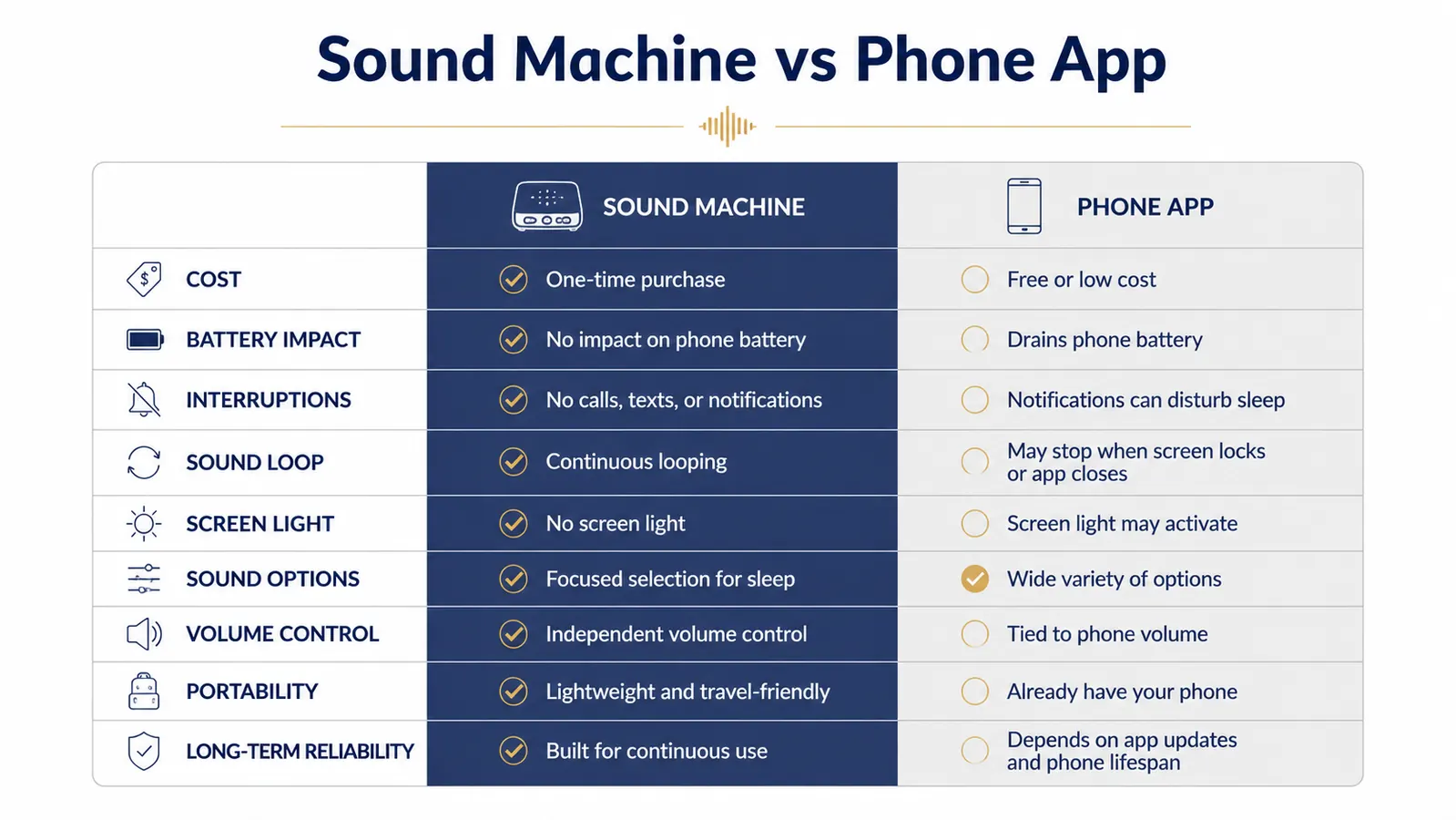
| White Noise Machine | Phone App | |
|---|---|---|
| Cost | One-time purchase | Free to modest monthly subscription fee |
| Battery Impact | None, plugs into wall outlet | Drains phone battery overnight |
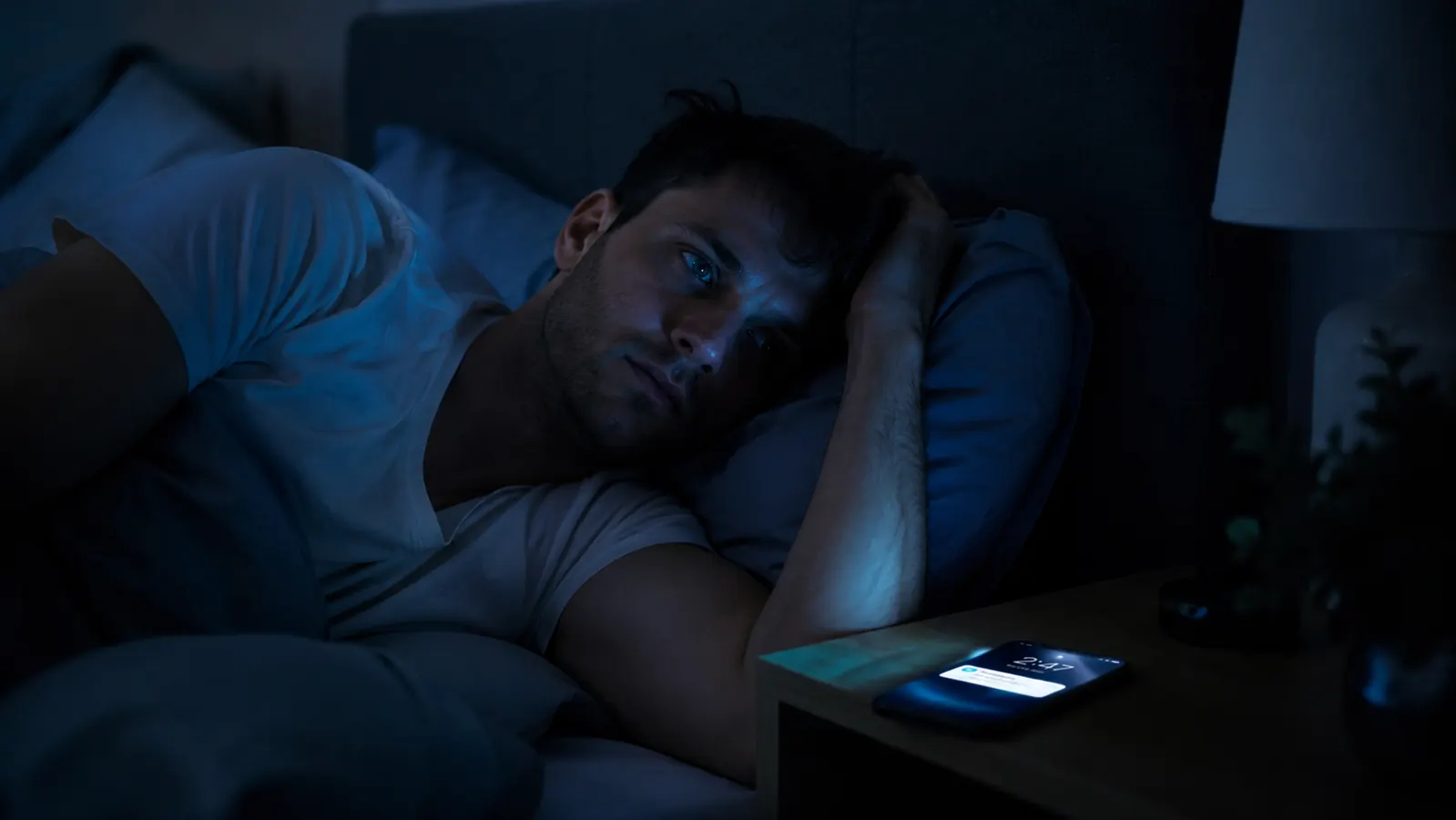
| Interruptions | Zero, no notifications possible | Calls, texts, alarms can break through |
| Sound Loop | Continuous, seamless tone all night | Many apps have audible 30-60 min loops |
| Screen Light | No screen, no light emitted | Screen may illuminate or wake sleeper |
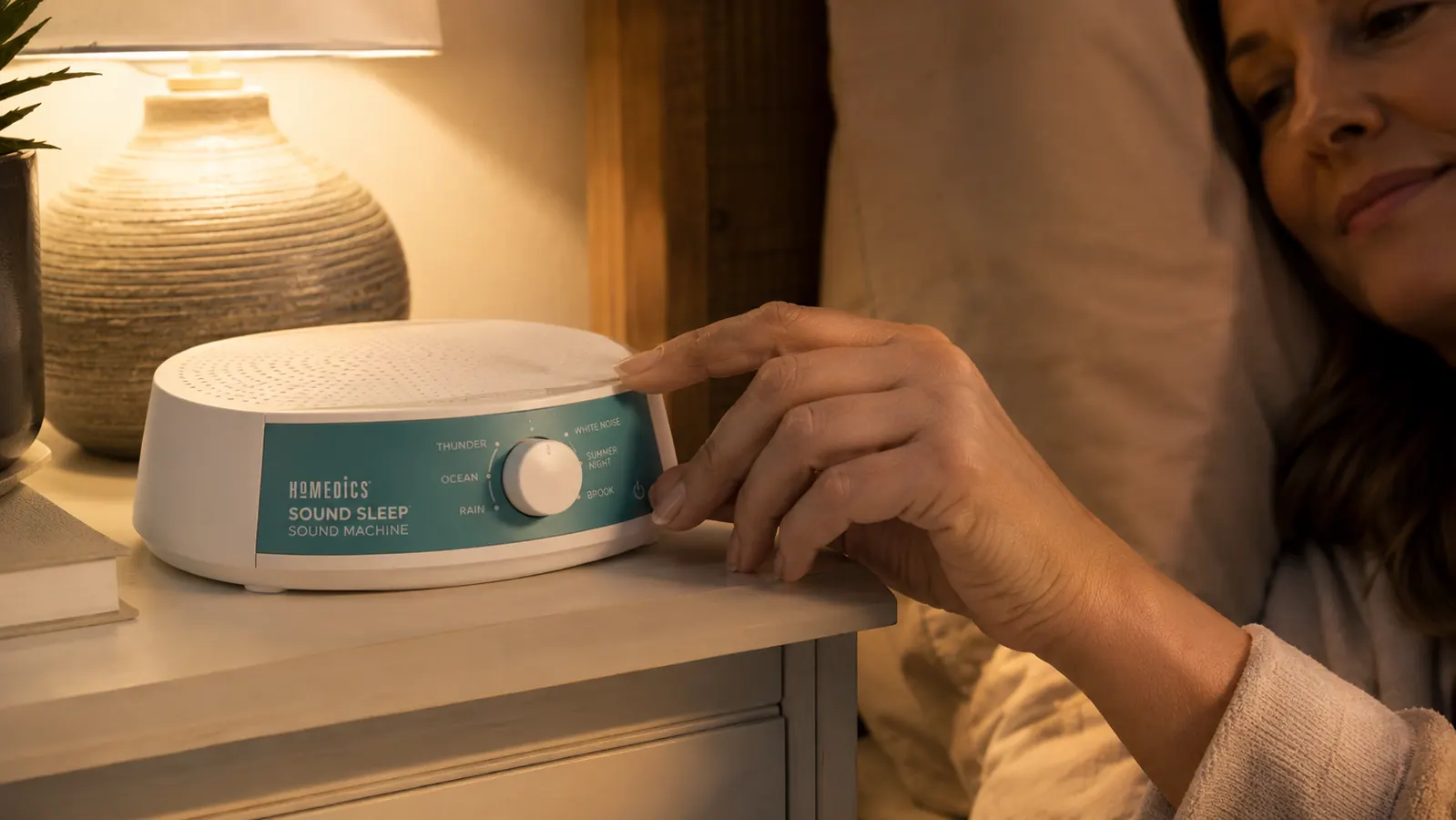
| Sound Options | 6 built-in sounds including white, pink, and thunder | Dozens to hundreds of sounds available |
| Volume Control | Physical dial, adjustable without opening eyes | Requires unlocking phone to adjust |
| Portability | Compact, travel-friendly, AC-powered | Uses your phone, no extra item to carry |
| Long-Term Reliability | Hardware runs indefinitely, no app updates | Apps get discontinued, paywalled, or changed |
Your Phone Has Notifications. Your Sound Machine Does Not.
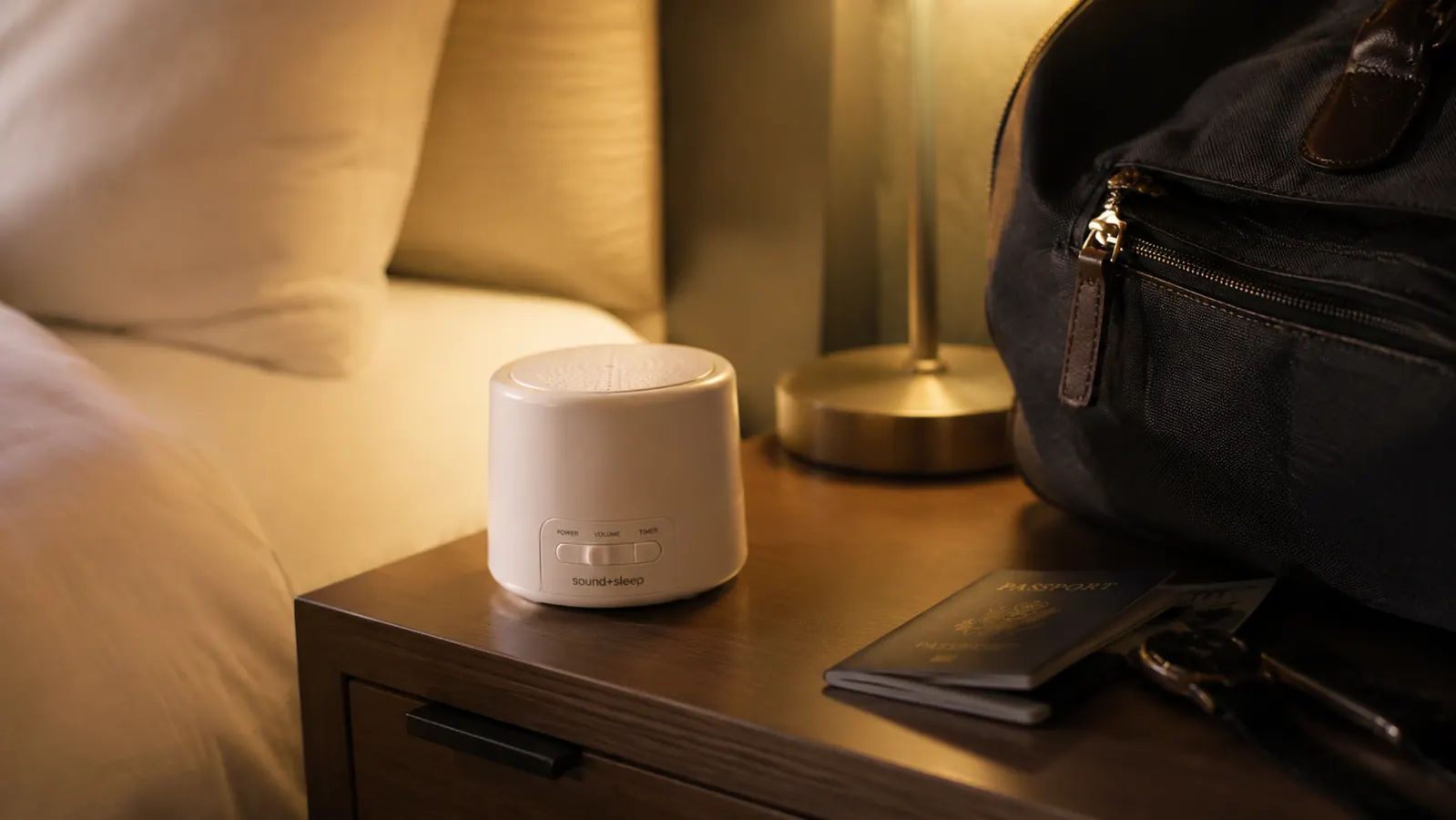
The Homedics SoundSleep runs all night on a steady loop with zero interruptions. No app updates, no charging prompts, no screen lighting up at midnight. Over 58,000 Amazon ratings back it up.
Amazon Check Today's Price on Amazon →Where the Homedics SoundSleep Wins
The biggest advantage is not sound quality or sound variety. It is separation. When your phone is your white noise machine, your phone is also your alarm clock, your notification center, your social media feed, and your anxiety spiral engine. Every one of those functions competes with sleep. You put the phone on Do Not Disturb and think you are safe, but then you start wondering if you will miss something urgent. Or the DND settings let one category through and that is the one that wakes you. The Homedics SoundSleep is an affordable slab of hardware that cannot receive a call, cannot update itself at 3am, and cannot show you anything. That simplicity is the feature.
The second practical edge is the physical volume dial. This sounds minor until you are half-asleep and the noise from the street suddenly gets louder. Reaching over and turning a knob without opening your eyes is easy. Unlocking your phone, navigating to an app, adjusting a slider, locking the screen again, and hoping the screen brightness did not fully wake you is not. I tell patients all the time: friction is the enemy of sleep. Every extra step between you and rest is a step backward. A physical knob removes that friction completely.
Third, loop quality matters more than most people realize before they experience it. Many white noise apps use audio files with a distinct beginning and end. That seam, where the recording loops back to the start, is often audible. For light sleepers, it is enough to pull them back toward consciousness repeatedly through the night. The Homedics SoundSleep uses a continuous tone generator rather than a recorded loop, which means the sound never resets. There is no seam to notice because there is no recording to loop.
Where a Phone App Wins
Variety is the obvious one. A good sleep app gives you rain on a tin roof, a crowded coffee shop, brown noise, pink noise, ocean waves, binaural beats, and thirty more options. The Homedics SoundSleep gives you six: white noise, thunder, ocean, summer night, brook, and rain. For most people, one or two sounds is all they need, so six is plenty. But if you have spent real time figuring out exactly which soundscape puts you under, a richer library matters. Some people genuinely sleep better to specific textures that a basic machine will not replicate.
The second win for the app is portability in the pure sense. If you travel and always have your phone, you always have your sleep sound. The Homedics SoundSleep is compact and travel-sized, so it packs easily, but it does require you to remember it and carry it. For frequent travelers who are already disciplined about what goes in the bag, that is a non-issue. For someone who forgets it on the nightstand at home, the phone app is the backup that will always be there.
The phone app is a fine starting point for figuring out whether sound masking helps you at all. But it is not a long-term sleep tool.
Why Sound Masking Works and What That Means for Your Choice
White noise masks disruptive sounds by raising the ambient sound floor of the room. It does not eliminate noise the way earplugs do. Instead, it narrows the contrast between silence and a sudden sound, so when a car door slams outside or a neighbor's dog decides 4am is an appropriate time to bark, your brain does not register it as a sharp intrusion. The startle response stays below threshold and you stay asleep. This is why consistency matters so much in how you deliver the sound. A tone that loops, cuts out, or varies in volume does the opposite of what you need. It keeps the contrast spiked, which is exactly what you are trying to avoid.
From a clinical standpoint, that is why I prefer hardware for patients who use sound masking seriously. The therapeutic benefit depends on uninterrupted, consistent delivery throughout the night. An app can do this when it works perfectly. But apps fail in ways hardware does not. The phone overheats. The OS prioritizes a background process and the audio skips. A software update changes the app's behavior. None of that happens with a dedicated machine running a continuous tone. The Homedics SoundSleep in particular has been on the market long enough, with enough verified buyer feedback, that its reliability track record is solid.
The Battery Problem Is Bigger Than It Sounds
Running audio all night at a meaningful volume is hard on a phone battery. Over time, this is a real cost. Lithium batteries degrade with charging cycles, and a phone that charges every single night because it runs audio all night will see that battery age faster than a phone that goes to bed at 80 percent. Most people do not connect those dots until they are replacing a phone two years earlier than expected. The Homedics SoundSleep plugs into a wall outlet. It uses your phone's charging port for nothing, which means your phone can charge fully and stop, or not charge at all.
There is also the interruption risk that Do Not Disturb does not fully solve. Even with the strictest settings, most phones allow a repeated call from the same number within a few minutes to ring through. Emergency alerts bypass DND by default on most carriers. If you are someone who has set up their phone specifically so that a family member can reach you in a real emergency, that is the right call, but it also means your sleep sound device is the same device that will ring at 2am if something goes wrong. That tension is real and a dedicated machine eliminates it entirely.
The Cost Comparison Is Not What It Appears
On the surface, a free app beats a dedicated machine. But most free apps are limited or ad-supported. The apps that are genuinely good and ad-free tend to run on a subscription model, commonly on a monthly basis. Over a year, that adds up. Over two years, it adds up significantly more. The Homedics SoundSleep is a one-time purchase and runs indefinitely. The math swings toward the machine fairly quickly for anyone who will actually use it consistently.
The other hidden cost of apps is discontinuation. Apps get acquired, rebranded, paywalled, or simply abandoned. If you have built a sleep habit around a specific app sound and that app disappears from the store or changes its model, you are starting over. Hardware you own does not get an update that removes your favorite feature. I have seen patients go through this once and it is genuinely disruptive, the same way losing any entrenched sleep habit is disruptive. Owning the physical device removes that dependency entirely.
Who Should Buy Which
Buy the Homedics SoundSleep if you already know you sleep better with background noise and you want to stop using your phone as a sleep device. It is also the right call if you share a room with someone whose sleep you want to protect from your screen, if you are a light sleeper who gets pulled awake by notification sounds, or if you are trying to build a more consistent sleep environment over time. At the budget end, it is a low-stakes commitment with a clear daily payoff. If you are a shift worker coming home at irregular hours and you need your bedroom to function as a sleep refuge regardless of what time it is outside, a dedicated machine is particularly useful because you can set it running before you even get into bed, without touching your phone at all.
Stick with the phone app if you are still in the experimenting phase and have not confirmed that sound masking actually helps your sleep. There is no point buying hardware until you know the concept works for you. Try a free app for two weeks. If you notice a real difference in how fast you fall asleep or how often you wake, that is the signal to upgrade to a dedicated machine. The app is a good audition. The machine is what you hire when the audition works.
I also lean toward the machine for anyone with a dog or a cat in the bedroom. My own animals are excellent at finding the exact moment I have drifted off to startle me back awake. A continuous background layer of white noise raises the threshold for what registers as a disturbance, which means the cat knocking something over in the hallway reads as less alarming. The phone app could technically do the same, but not without the trade-offs already covered. A machine that runs quietly and unattended while your phone charges in the kitchen is a cleaner setup in every way.
Still Using Your Phone? Here Is What You Are Missing.
A dedicated machine costs less than a month of most sleep apps and never drains your battery, pings you, or gets discontinued. The Homedics SoundSleep is what I recommend to patients who tell me they sleep with noise but still wake up tired.
Amazon See Current Price on Amazon →