
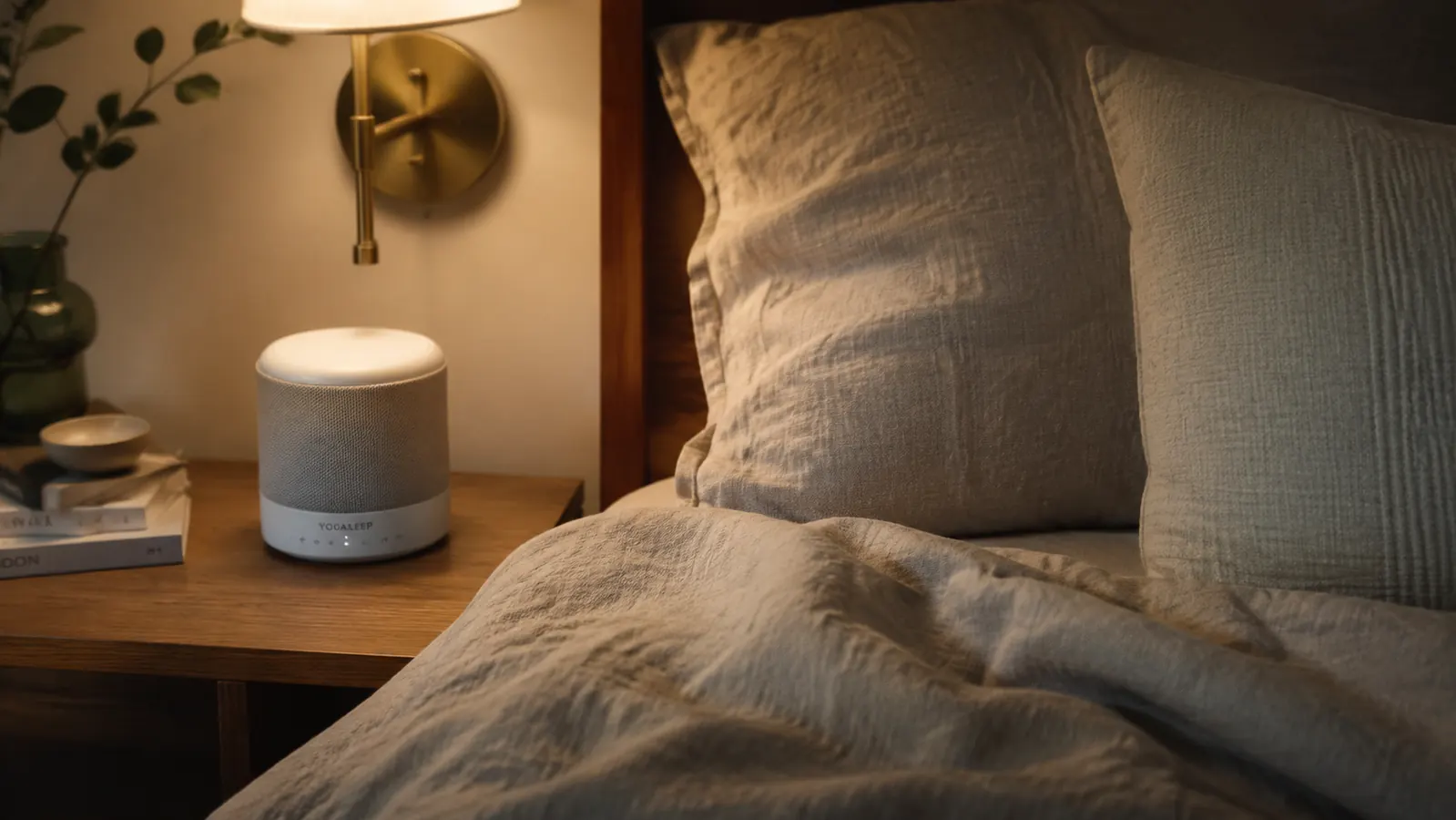
My patient Diane came in one Thursday morning looking like she had not slept in a week, because she basically hadn't. Her upstairs neighbor had a dog that paced at 2am. Her husband snored. The street outside filled up with delivery trucks by 5:30. She'd tried foam earplugs and hated the pressure against her ear canal. She'd tried a sleep app on her phone, but the sound cut out when her screen dimmed. She asked me if there was anything else. I told her yes, and it costs less than a dinner out. A white noise machine, specifically a dedicated sound machine designed to run all night, placed correctly in her bedroom, changed her situation in four nights. This guide walks through the same five-step approach I gave her.
None of these steps require renovation or expensive gear. You don't need to soundproof your walls or install new windows. You don't need earplugs that hurt or a phone propped up against a charger all night. What you need is a consistent masking sound, placed right, at the right volume, inside a bedroom that is set up to help rather than hurt. Let's go through it.
If noise is keeping you awake, this is the tool I point every patient toward first.
The Homedics SoundSleep white noise machine has 6 sound options, runs all night on a single power cord, and has nearly 59,000 Amazon ratings at 4.5 stars. Budget-friendly. No subscription. No app to manage.
Amazon Check Today's Price on Amazon →Step 1: Understand Why White Noise Works (So You Use It Right)
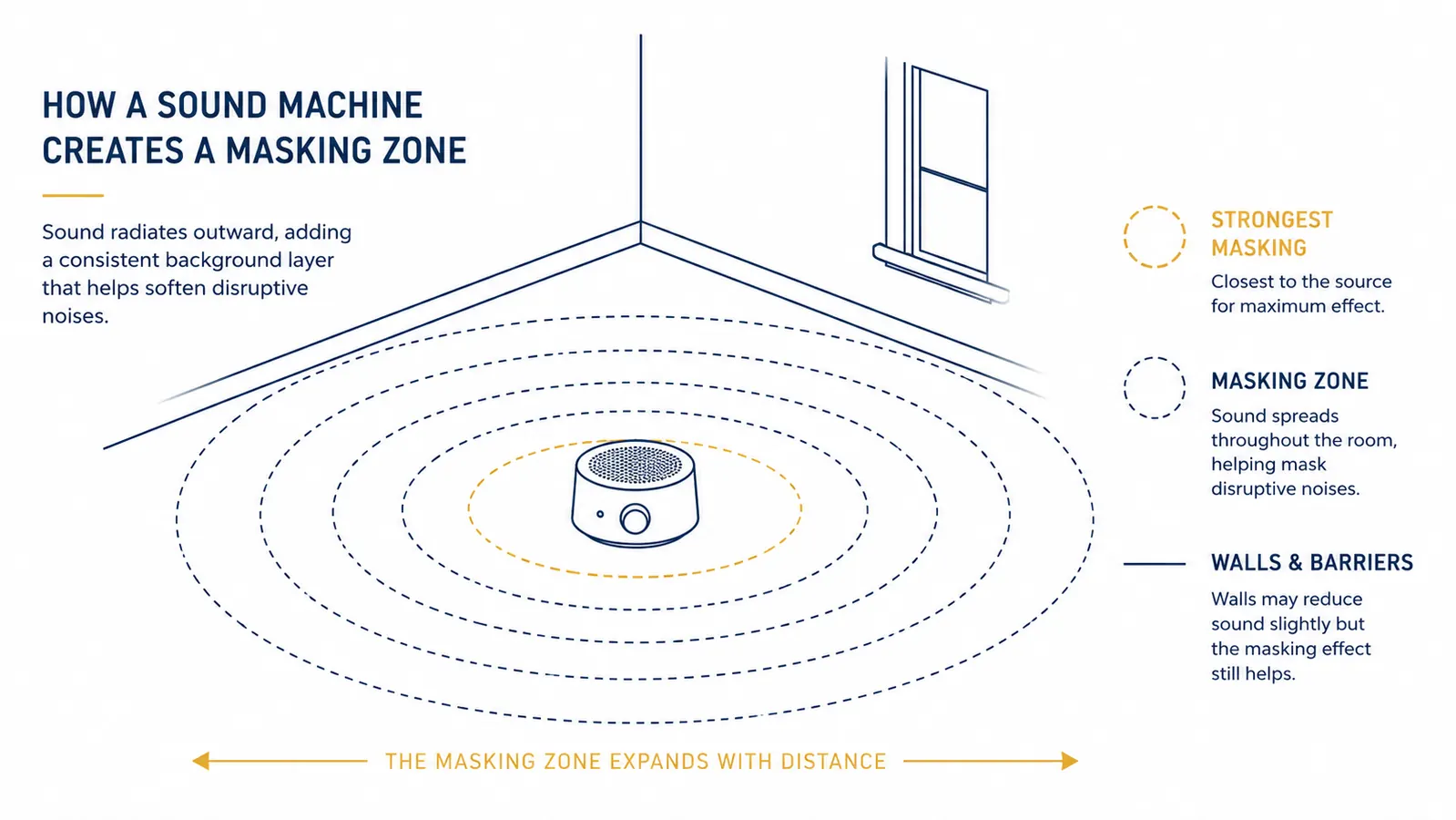
A white noise machine does not make your bedroom silent. That's important to understand before you start. What it does is raise the ambient sound floor of the room so that sudden noises, a car door, a dog, a toilet flushing two walls over, don't spike as sharply against the quiet. Your brain reacts to contrast, not to volume alone. When the background is steady and consistent, individual sounds lose their ability to jolt you awake. Sleep researchers call this auditory masking, and it's the same reason you can sleep through a fan but not through a dripping faucet.
A dedicated sound machine produces that consistent background more reliably than a fan because the sound is specifically designed for sleep masking. No mechanical vibration that changes pitch when the motor warms up, no airflow pushing at your face, no rattling grille at 3am. The Homedics SoundSleep, which is the machine I most often recommend to patients, offers six sounds including white noise, brown noise, and nature options like ocean and rain. Most of my patients land on white noise or brown noise because those cover a broad frequency range, which addresses more of what actually wakes people: traffic, voices, footsteps above. Nature sounds like rain work well for some, but they can loop in ways you notice once your brain learns the pattern.
The key thing to carry into the next steps is this: a sound machine is a masking tool, not a silence tool. You are not trying to eliminate noise. You are trying to shrink the gap between the room's baseline sound level and the disruptive noise. When that gap narrows, your brain stops treating each sound as a signal worth waking up for.
Step 2: Place Your Sound Machine Where the Noise Is Coming From
This is the step most people skip, and it matters more than they expect. Most people put the sound machine on the nightstand directly next to their head. That works fine if the noise source is from all directions or undefined. But if your problem is a specific wall, like a shared wall with a neighbor, or a window facing a busy street, put the white noise machine between you and that source. On the dresser near the window. On the floor near the shared wall. The masking effect is strongest close to the source because the machine's sound reaches you after passing through, or at least near, where the problem sound enters.
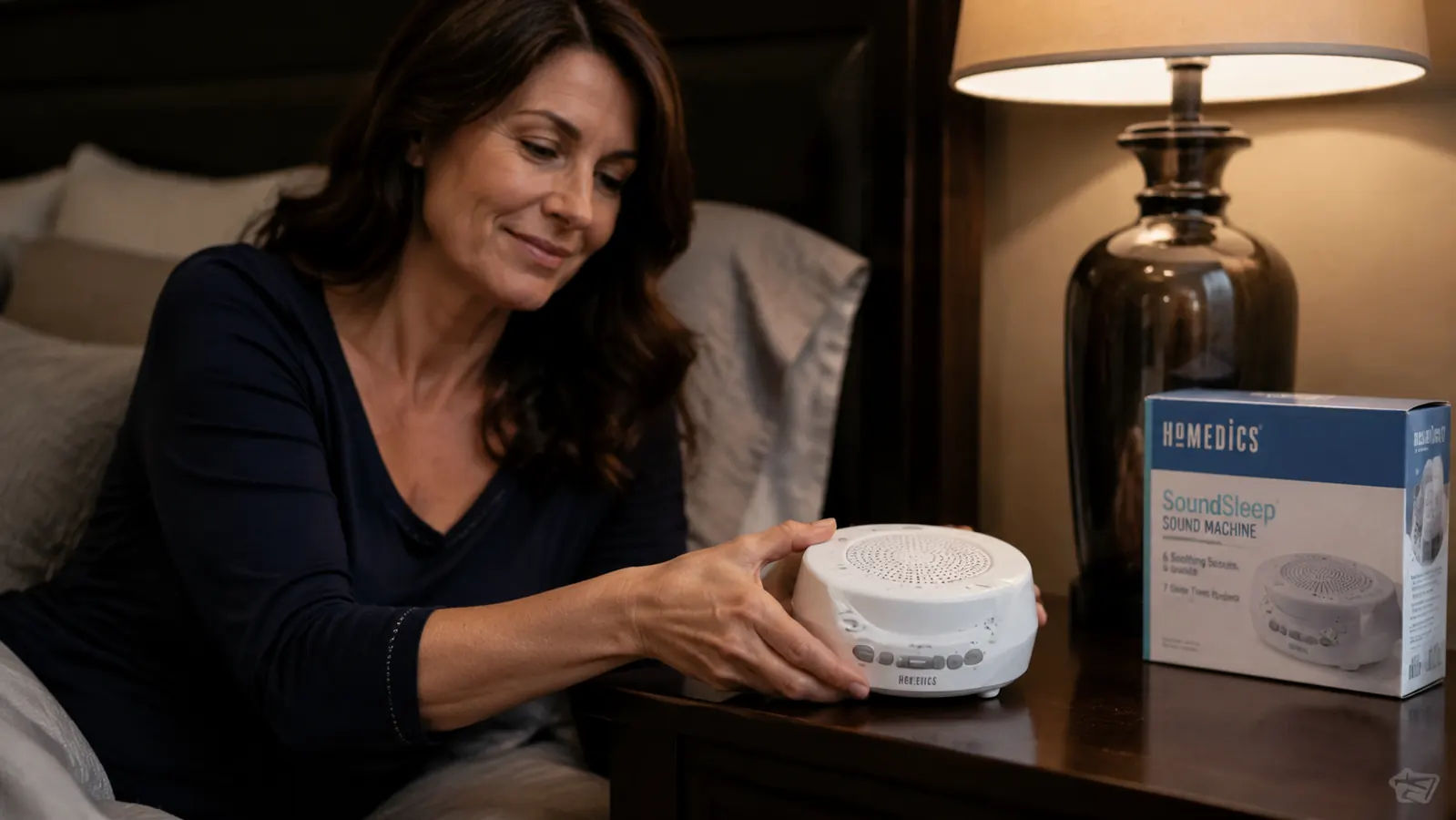
The Homedics SoundSleep is compact enough to go almost anywhere. It's roughly the size of a large coffee mug, just a few inches across. I've had patients put it on the windowsill behind the curtain, on the floor near the base of a door, even on top of a bookshelf angled toward a noisy corner. The cord is long enough to reach most standard outlets without an extension. Try it in two or three different spots over a week before you decide it's not working. Placement alone can make the difference between a tool that helps and one that sits collecting dust.
Step 3: Set the White Noise Volume to Cover the Noise Without Disturbing Sleep
White noise at the right volume is sleep-neutral. White noise too loud is just another noise. The general guidance from sleep researchers is to keep a white noise machine below 70 decibels, which is roughly equivalent to a normal conversational volume. In practice, that means loud enough that you notice it when you walk into the room, but not so loud that you have to raise your voice to talk over it. If you are turning the sound machine all the way up to maximum and you can still clearly hear your neighbor through it, the issue is not the volume dial. It's placement or room construction. Return to Step 2 before cranking the machine louder.
The Homedics SoundSleep has a simple analog volume dial rather than a digital preset system, which I actually prefer for bedroom use. You can fine-tune it in small increments by feel without staring at a screen. Start at roughly 40 percent and adjust across a few nights until you find the level where outside noise recedes but the machine itself isn't the thing you're listening to. Most adults find somewhere in the lower-to-middle range works well. If you have a sleeping partner, agree on a shared volume before one of you decides it's too loud and turns it off at midnight.
Your brain reacts to contrast, not to volume alone. A steady background sound takes the spike out of sudden noise, and that's what keeps you asleep.
Step 4: Address the Room Itself With Simple Acoustic Fixes
A sound machine does most of the work, but your bedroom either helps or undermines it. Hard floors, bare walls, and uncovered windows all reflect sound, which means noise from outside bounces around inside your room rather than getting absorbed into soft surfaces. You don't need to hang acoustic foam or install specialized panels. What actually makes a measurable difference for most people is simpler: a rug on a bare hardwood or tile floor, curtains that hang floor to ceiling rather than stopping at the window frame, and a bookshelf or an upholstered headboard on a wall you share with a noisy neighbor. Soft surfaces absorb. Hard surfaces reflect. Every soft surface you add gives the sound machine a little less work to do.
Weather stripping on a drafty door or window is also worth checking. Gap sound travels through gaps with almost no loss. In older buildings especially, the space at the bottom of an interior bedroom door lets hallway noise bleed straight in. A door sweep or even a rolled-up towel along the bottom can noticeably reduce what you hear from the rest of the apartment or house. These are not glamorous solutions. But combined with a sound machine running steady white noise, they give you a layered approach where each fix reduces the load on the others. No single element has to work perfectly.
Step 5: Run the Sound Machine All Night, Not Just at Sleep Onset
Sleep apps and phone-based white noise have one persistent problem: the sound stops partway through the night. The screen times out, the battery dies, or the app pauses for a notification. That silence, after an hour or two of your brain conditioning itself to the masking sound, is itself a disruption. You surface into a light sleep stage, notice the quiet is different from how you fell asleep, and wake up trying to figure out why. A dedicated sound machine like the Homedics SoundSleep runs on continuous power from a wall outlet and stays on until you turn it off. No timer to remember, no battery level to check, no app to babysit.
Some people ask me whether running a sound machine all night every night is safe long-term. The research on this is generally reassuring. Consistent low-level white noise at the volumes used for sleep does not damage hearing, and most adults acclimate to it within about a week, meaning they stop consciously noticing it at bedtime and simply sleep. A small number of patients find white noise itself slightly grating over time. If that happens, switching to brown noise or one of the nature sounds on the Homedics machine usually resolves it. Brown noise is lower-pitched and many people find it more neutral. The machine gives you six options, so you're not locked into the one that isn't working for you.
What Else Helps When Noise Is a Chronic Problem
If you have worked through all five steps and noise is still pulling you out of sleep regularly, a few additional things are worth addressing. First, check your sleep habits themselves. Alcohol, late meals, and screen use close to bedtime all suppress deep sleep and push you into lighter, more fragmented cycles, which makes you substantially more reactive to sound. A sound machine masks noise well, but its effectiveness is partly dependent on how deep your sleep is underneath it. If you're sleeping lightly for other reasons, the threshold at which sounds wake you drops. Getting those habits in order makes the masking more effective, not less.
Second, if the noise keeping you awake is a sleeping partner who snores, a sound machine helps but is not a complete solution for severe snoring. I always encourage patients to address the snoring itself. Side-sleeping position changes, nasal strips, and in persistent cases a referral for a sleep study are all worth pursuing. The sound machine buys you meaningful relief while you work on the underlying problem. It is not a reason to avoid that conversation.
Third, for shift workers sleeping during daylight hours, a white noise machine pairs well with blackout curtains because it addresses both main disruptions at once: sound from a neighborhood that's awake, and light coming in at the wrong time for your schedule. The combination is significantly more effective than either one alone. I have patients who work overnight shifts who call this setup the closest thing they've found to sleeping in a proper nighttime environment regardless of what time the clock says outside.
For most people, the five steps above are enough. I have seen patients go from waking two or three times a night due to noise to sleeping through consistently, with nothing more than a sound machine placed correctly and a few simple changes to the room. Diane texted me a week after our appointment to say she had not heard the upstairs dog once. That's not because the dog stopped pacing. It's because the white noise machine was doing its job, and her bedroom was finally set up to let it.
Your sleep environment changes the day you stop fighting noise and start masking it.
The Homedics SoundSleep is the sound machine I recommend most. Simple volume dial, 6 sound options including white noise and brown noise, compact enough to place anywhere in the room, and it runs all night from a wall outlet. Nearly 59,000 Amazon ratings. Check the current price below.
Amazon Check Today's Price on Amazon →